

 Tapeworm (Taenia solium) Infection – Cysticercosis Symptoms
Cysticercosis is caused by ingesting the eggs of Taenia solium, the pork tapeworm. After the consumption of eggs or a gravid proglottid, the eggs hatch into larvae, which are distributed systemically via the blood after penetrating the walls of the GI tract.1 The larvae can lodge in various tissues, including the skin, skeletal muscles, eyes, spleen, pancreas, and heart, to cause cysticercosis. Cysticercosis severity can range from asymptomatic to life-threatening.1,2
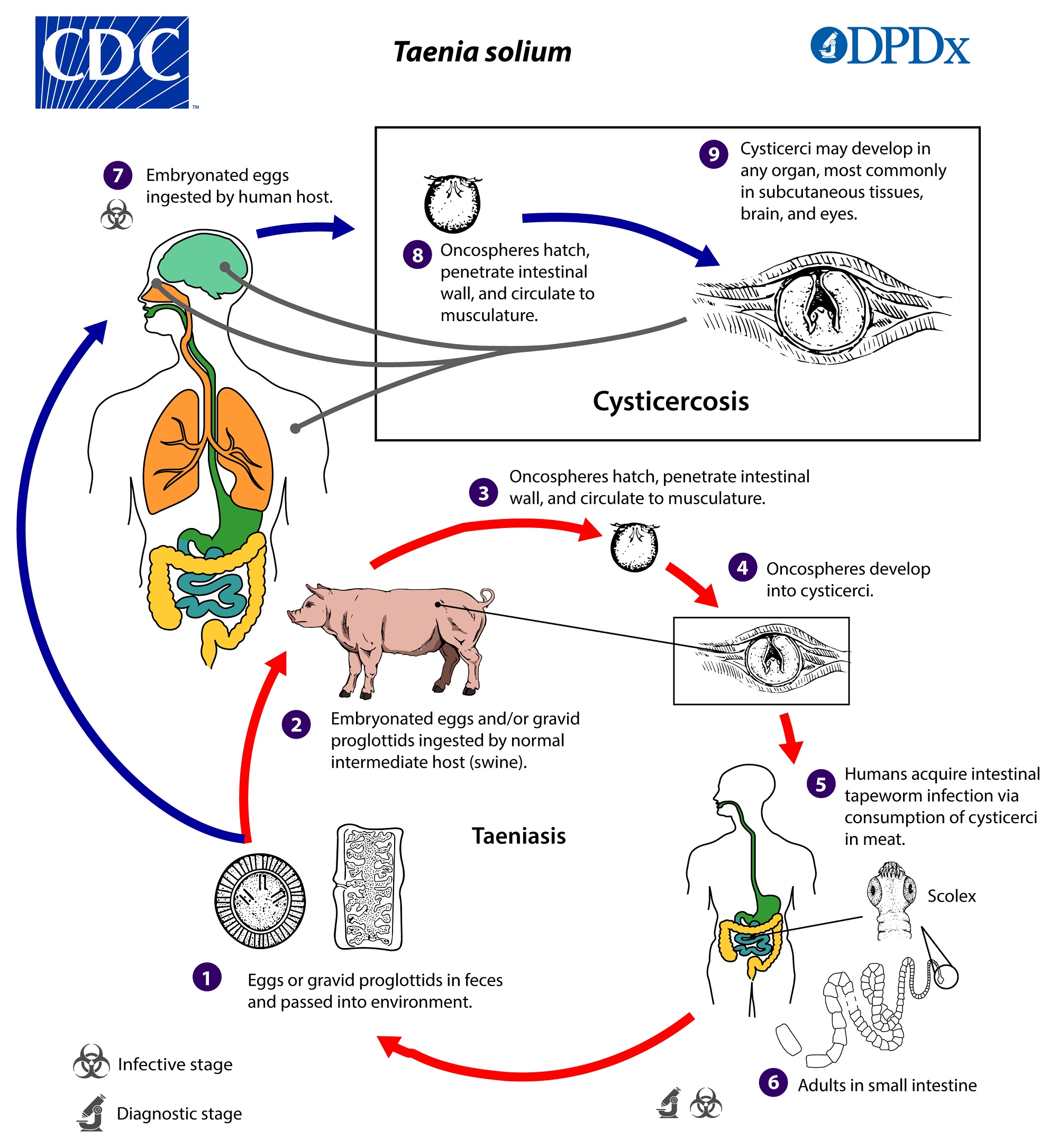
Image Source: How Cysticercosis Spreads | Cysticercosis | CDC
Signs and symptoms of cysticercosis depend on the location of the larvae and may include:
- Soft lumps beneath the skin3
- Pseudohypertrophy of muscles1,2
- Cardiovascular signs and symptoms:
- Chest pain
- Palpitations
- Arrhythmias
- Cardiac conduction disturbances
- Pericardial effusion
- Heart failure
- Syncope
- Shortness of breath
- Cardiac valve dysfunction4
- Myocarditis5
- Arterial hypertension5,6
- Ocular cysticercosis signs and symptoms:
- Subconjunctival cysts
- Subretinal cysts
- Papilledema
- Atypical optic neuritis
- Lid nodules
- Intraretinal cysts7
- Proptosis with restricted ocular movements4,7
- Vision changes4
- Loss of vision
- Periorbital redness and swelling8
- Deviations in gaze9
When the cysticerci affect the muscles, the clinical presentation can be of the myalgic type, nodular type, or the uncommon pseudohypertrophic type. A rare condition known as ‘disseminated muscular cysticercosis syndrome’ is characterized by muscular pseudohypertrophy, palpable subcutaneous nodules, and seizures with abnormal mentation. The muscles affected by pseudohypertrophy are generally nontender.1
 Image Source: DISSEMINATED CYSTICERCOSIS WITH HUGE MUSCLE HYPERTROPHY – PMC
Cardiac Cysticercosis and Neurocysticercosis
While the most common clinical presentation involves the nervous and musculoskeletal systems, up to 25% of cases of cysticercosis cases can involve the cardiovascular system. Cardiac cysticercosis is often asymptomatic; however, it can present with severe symptoms, including sustained ventricular tachycardia. Fortunately, timely and appropriate anthelmintic treatment combined with corticosteroids can be curative, even in cases of cardiac cysticercosis.4
Cysticercosis is associated with early mortality, morbidity, and disability. Roughly 20 million individuals suffer from T. solium cysticercosis globally, leading to approximately 50,000 deaths each year. And, as more people migrate from regions where T. solium is endemic, the prevalence of cysticercosis continues to increase in developed nations.3 Morbidity is most commonly caused by the involvement of the eyes or CNS.1 Neurocysticercosis in the CNS is the deadliest form of tapeworm infection, and discussed in more detail at the link below.3
More information is available at these links:
- Tapeworm Infection – Neurocysticercosis (NCC) Symptoms – DiagnosTechs, Inc.
- Diagnose Taeniasis (Tapeworm Infection) – Stool Test for Intestinal Parasites – DiagnosTechs, Inc.
- Symptoms of Taeniasis (Taenia solium Infection) – DiagnosTechs, Inc.
- Best Stool Test for Intestinal Parasites – DiagnosTechs, Inc.
- Is It A Worm? Is It A Parasite? TEST – Don’t Guess! – DiagnosTechs, Inc.
- Taenia solium (Tapeworm) Treatment Protocols
- Complete GI Parasite List
- Resources on Diagnosis of Parasitic Diseases
- Tapeworm (Taenia solium) Treatment – Taeniasis, Cysticercosis, and Neurocysticercosis (NCC) – DiagnosTechs, Inc.
- Tapeworm (Taenia solium) Infection Prevention – DiagnosTechs, Inc.
- How Common Are Tapeworms (Taenia solium) in the US? – DiagnosTechs, Inc.
- Saliva Screening Test for Taeniasis, Cysticercosis, and Neurocysticercosis (NCC) – DiagnosTechs, Inc.
To place a test order, click here. As a reminder, DiagnosTechs will drop ship test kits directly to your patients.
 References:
- Bandyopadhyay D, Sen S. Disseminated cysticercosis with huge muscle hypertrophy. Indian J Dermatol. 2009;54(1):49-51. doi:10.4103/0019-5154.48987
- Vaidya A, Singhal S, Dhall S, et al. Asymptomatic disseminated cysticercosis. J Clin Diagn Res. 2013;7(8):1761-1763. doi:10.7860/JCDR/2013/5465.3269
- Kusnoto K, Khairullah AR, Sunarso A, et al. The hidden threat of cysticercosis: A neglected public health problem. Open Vet J. 2025;15(3):1101-1115. doi:10.5455/OVJ.2025.v15.i3.4
- García-Martínez CE, Scatularo CE, Farina JM, et al. Cysticercosis & Heart: A Systematic Review. Curr Probl Cardiol. 2023;48(8):101195. doi:10.1016/j.cpcardiol.2022.101195
- Shogan PJ, Yasmer JF, Monson M. Cardiac cysticercosis. AJR Am J Roentgenol. 2009;192(5):W212-W213. doi:10.2214/AJR.08.2000
- López-Hernández A, Garaizar C. Childhood cerebral cysticercosis: clinical features and computed tomographic findings in 89 Mexican children. Can J Neurol Sci. 1982;9(4):401-407. doi:10.1017/s0317167100044309
- Vaibhav, Sharma R, Aggarwal HK, et al. Neurocysticercosis-Induced Monoparesis: A Case Report of a Rare Neurological Manifestation. Cureus. 2024;16(6):e62587. doi:10.7759/cureus.62587
- Shen ZZ, Luo HQ. Changing Trends in the Cysticercosis-Related Disease Burden from 1990 to 2021 and its Predicted Level in 2022-2050 Years. Acta Parasitol. 2025;70(3):118. doi:10.1007/s11686-025-01058-3
- Gonzales I, Rivera JT, Garcia HH; Cysticercosis Working Group in Peru. Pathogenesis of Taenia solium taeniasis and cysticercosis. Parasite Immunol. 2016;38(3):136-146. doi:10.1111/pim.12307